
Every winter, families across South Korea prepare for one of the most important holidays of the year: Seollal (설날), the Korean Lunar New Year.
More than just the first day of the lunar calendar, Seollal is a time of family reunion, ancestral remembrance, traditional food, and cultural rituals that have shaped Korean society for centuries.
While modern cities like Seoul slow down for only a few days, the emotional and cultural weight of Seollal remains deeply rooted in everyday Korean life.
The Meaning of Seollal
Seollal marks the first day of the lunar calendar, usually falling in late January or early February. Unlike the Western New Year on January 1st, Seollal follows the traditional East Asian lunisolar system.
Historically, the holiday dates back to ancient Korean kingdoms, when the lunar calendar guided agricultural life. The new year symbolized renewal — not just of time, but of family bonds, responsibilities, and respect for ancestors.
Seollal is officially a three-day public holiday in South Korea:
- The day before Seollal
- Seollal Day
- The day after
During this period, millions of people travel to their hometowns, creating one of the largest annual migrations in the country.
Charye: Honoring the Ancestors
One of the most important Seollal rituals is Charye (차례) — an ancestral memorial ceremony.
Families prepare a carefully arranged table of traditional foods to honor their ancestors. The table layout follows traditional rules, often passed down through generations.
Typical Charye foods include:
- Rice and soup
- Various jeon (savory pancakes)
- Grilled fish and meat
- Fruits arranged in specific colors and positions
The ceremony reflects Confucian values that strongly influenced Korean society, emphasizing respect, hierarchy, and family continuity.
For many Koreans, Seollal is less about celebration and more about remembrance and gratitude.

Sebae: The Deep Bow of Respect
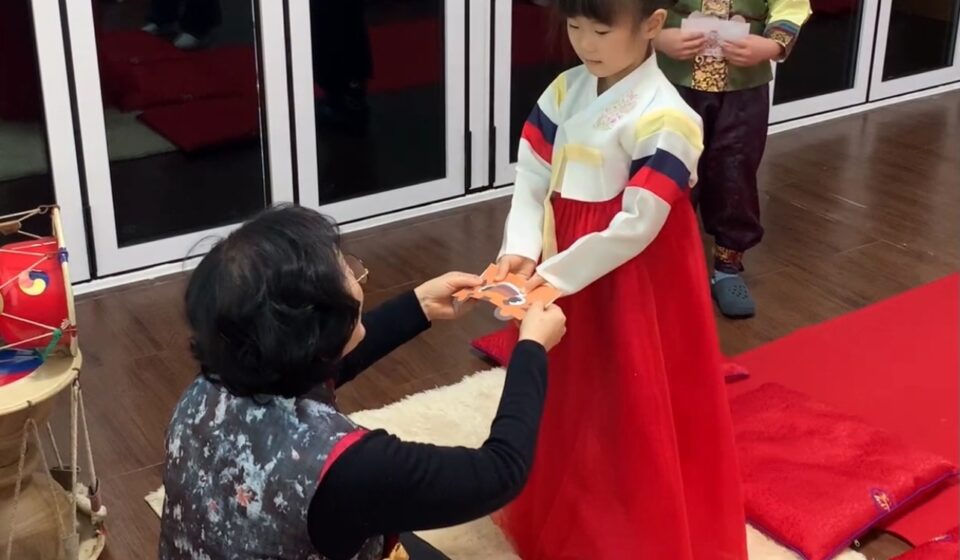
After the ancestral ritual, younger family members perform Sebae (세배) — a formal deep bow to elders.
Children kneel and bow fully to their grandparents and parents, saying:
“Saehae bok mani badeuseyo.”
(May you receive many blessings in the New Year.)
In return, elders give words of advice and often present Sebaetdon (세뱃돈) — New Year’s money.
This moment beautifully illustrates the Confucian structure of Korean family life, where age and respect shape social relationships.

Tteokguk: The Soup That Makes You Older
No Seollal is complete without Tteokguk (떡국) — a soup made with thinly sliced rice cakes.
Traditionally, eating a bowl of tteokguk symbolically adds one year to your age. In fact, Koreans used to calculate age by the number of New Years they had experienced.
The white rice cakes represent purity and a fresh start, while their coin-like shape symbolizes prosperity.
Traditional Games and Hanbok
Seollal is also a time for traditional games and clothing.
Many people wear Hanbok (한복), Korea’s traditional attire, especially for family gatherings and ceremonies.
Popular traditional games include:
- Yutnori (a board game using wooden sticks)
- Jegichagi (similar to hacky sack)
- Kite flying
In rural areas and cultural villages, visitors can still see large-scale traditional performances during Seollal.

Seollal in Modern Korea
Although contemporary life has changed dramatically, Seollal remains central to Korean identity.
Modern elements now include:
- Online money transfers instead of cash envelopes
- Shorter ritual ceremonies
- Holiday travel abroad
- Department store gift sets replacing homemade preparations
However, the core values remain the same:
- Family reunion
- Respect for elders
- Reflection on the past year
- Hope for prosperity in the coming year
Even in high-rise apartment complexes across Busan and other cities, Seollal brings a noticeable quietness as families gather indoors.
Experiencing Seollal as a Visitor
For travelers, Seollal can feel both fascinating and challenging.
Many businesses close during the main holiday day, and transportation systems become extremely crowded before and after the holiday.
However, cultural sites and museums often host special programs. Places such as:
- National Folk Museum of Korea
- Korean Folk Village
offer demonstrations of traditional games, hanbok experiences, and ceremonial reenactments.
Visiting during Seollal provides a rare opportunity to witness Korea at its most authentic — centered around home rather than tourism.

More Than a Holiday
Seollal is not simply Korea’s version of New Year’s Day. It is a living tradition that reflects centuries of agricultural rhythms, Confucian philosophy, and family-centered culture.
In a rapidly modernizing society, Seollal remains a moment when time slows down, generations reconnect, and the past meets the present.
If you want to understand Korea beyond its cities and technology, start with Seollal.
Because in Korea, the year truly begins at home.